Unit 1 (part B) - Research Methods
Ms. Tompkins' Version:
|
| ||
Experimental Design
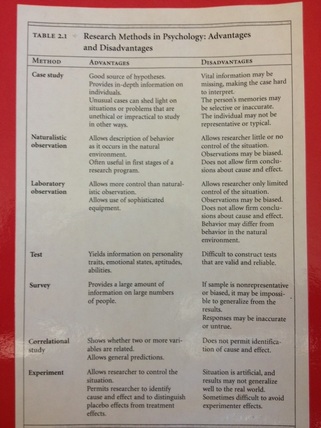
With a partner, discuss the following scenarios/questions. Then, look at the key.
1. A newspaper headline reads, Heavy Drinkers Get Lower College Grades. What would you conclude from this headline? What type of study was this based on?
2. People remember concrete words better than abstract ones. Could this finding have come from an experiment? Would it be reasonable to infer that concreteness facilitates memory?
3. Are people who were abused as children more likely than others to become child abusers? What type of study would be used to research this question?
4. A health magazine reports that depressed people who continue medication for at least six months are less likely to relapse than are people who take medication for less than six months. What would you need to know about the design of this study, in order to interpret the report?
5. A private school advertises that a group of their students recently scored 10 points higher on a math test than a group of other students from a public school. What can you conclude from this advertisement? Is this an example of an experiment?
1. A newspaper headline reads, Heavy Drinkers Get Lower College Grades. What would you conclude from this headline? What type of study was this based on?
2. People remember concrete words better than abstract ones. Could this finding have come from an experiment? Would it be reasonable to infer that concreteness facilitates memory?
3. Are people who were abused as children more likely than others to become child abusers? What type of study would be used to research this question?
4. A health magazine reports that depressed people who continue medication for at least six months are less likely to relapse than are people who take medication for less than six months. What would you need to know about the design of this study, in order to interpret the report?
5. A private school advertises that a group of their students recently scored 10 points higher on a math test than a group of other students from a public school. What can you conclude from this advertisement? Is this an example of an experiment?

|
| ||||
Study Summary Study:
| rosenthal_-_teachers-expectancies |
| study_summary_sheet.pdf |
Statistics
Read this LINK on why statistics are necessary to psychology
|
Ms. Tompkins' Version:
|
Ms. Chiavetta's Version:
| ||
| dice_roll_activity.pdf |
Ethics
| apa_ethical_guidelines_reading.pdf |
| jigsaw_activity.pdf |
| ethics_practice_sheet.pdf |
Tools to help study for Unit 1 (A&B) TEST
Use your notes,your AP Objectives Self-Assessment Sheets, this website, assignments, and the following tools:
Flashcards (made by another teacher...not me):
Flashcards (made by another teacher...not me):
- Research Methods FLASHCARDS
- THESE FLASHCARDS cover much of Unit 1 AND 2
| study_guide_-_unit_1_-_foundations_of_psych.pdf |
|
|
|
|
